With the ongoing Russia-Ukraine war, supplies of food grains like Wheat, Barley etc. from Ukraine and Russia has dwindled – triggering a food supply crisis globally. But Bangladesh’s food safety has not taken a big hit due to increased domestic production. What government intervention and policy changes lead to increased food security? How private initiatives also helped the process?
Food prices have proven to be a bane of inflation throughout the world. Usually, turbulent times hit the poorest of the world, which is essentially the same this time around. However, this time the crisis has not spared Europe even. Since COVID, the FAO real international food price index has seen a surge, unprecedented in the 21st century, as per IFPRI calculations.
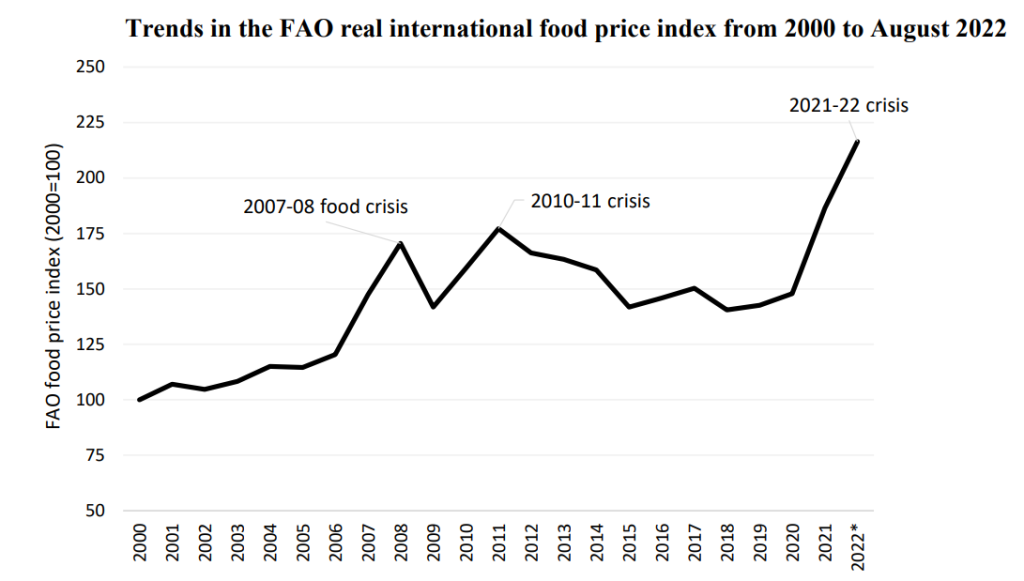
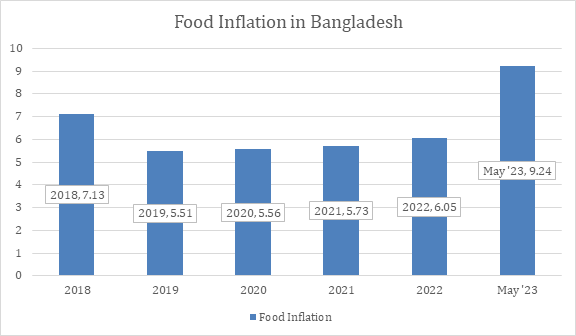
However, Bangladesh’s food inflation had a declining trend before the pandemic. In fact in 2019 food inflation decreased from 7.13% to 5.51%. Since the breakout of COVID, there has been a steady increase. But in February 2023, British supermarkets were rationing fruit and vegetables due to supply shortage. Bangladesh has avoided such scenarios as food rationing and scarcity although there has been a sharp increase in Consumer Price Index which stood at 9.24% in May, the highest in more than a decade.
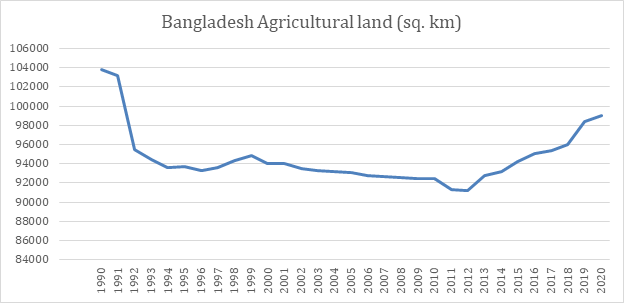
Until the pandemic, agriculture sector of Bangladesh has achieved consistent growth which is largely attributable to the farmers of Bangladesh who make up 40% of the workforce and contributes to 14% of the GDP. While the share of Agriculture to GDP has been on the decline for more than decade the size of it in the same period has increased to BDT 393.09 Billion. The decline in the share of agriculture to GDP is a positive trend for Bangladesh. It indicates that the country’s economy is becoming more diversified and less reliant on agriculture. This is important for Bangladesh’s long-term economic growth.
Increased Agricultural Production: Bangladesh’s agricultural industry has consistently increased productivity. The country’s food grain output climbed from 32.1 million metric tons in 2008-09 to 49.7 million metric tons in 2021-22, showing an average growth rate of 2.4% yearly, according to data from the Bangladesh Bureau of Statistics (BBS).
Rice Self-Sufficiency: Bangladesh has made tremendous progress toward being self-sufficient in rice. According to Food and Agriculture Organization (FAO) figures, Bangladesh produced 98% of its own rice in 2019, exceeding the government-set goal of 95%. The adoption of high-yielding rice cultivars, enhanced irrigation capacity, and improved availability to agricultural inputs have all been credited with this success.
Growth in Horticulture and Non-Traditional Crops: The horticulture sector has shown impressive expansion in recent years. Vegetable production increased by 83.1%, from 12.58 million metric tons in 2010–11 to 24.35 million metric tons in 2021–22. Similar to this, fruit production climbed by 114.4% from 6.94 million metric tons in 2010–11 to 15.93 million metric tons in 2021–22. Along with improving nutritional food security, this crop diversification has given farmers more chances to make money.
Investing in irrigation and water management: Infrastructure for irrigation and water management, including as dams, canals, and pumps, has received significant government investment. Due to this, crop yields have increased and the likelihood of crop failure from drought or flooding has decreased. More than 10,000 new irrigation pumps have been built by the government, and more than 10,000 older pumps have been repaired. Over 2 million hectares of land has been irrigated as a result of this. Crop yields have risen by 20% on average as a result. This has improved the livelihoods of millions of farmers and reduced food insecurity.
Promoting crop diversification: In order to encourage farmers to move to high-value crops like vegetables and fruits, the government offers incentives. This has contributed to a decrease in food insecurity and an increase in agricultural income. For instance, the government offers subsidies to farmers that transition to producing fruits and vegetables. This has contributed to a more than 50% increase in the area used for vegetable and fruit growing. As a result, agricultural exports have seen an average 15% gain in value. Millions of farmers’ livelihoods have been improved as a result.
Adoption of Technology and Innovation: To increase productivity and efficiency in the agriculture industry, Bangladesh has embraced innovation and technology. For instance, the widespread use of contemporary equipment like combine harvesters and power tillers has decreased labor-intensive procedures and enhanced production. Land preparation, irrigation, threshing, and pesticide application are the operations that are most intensively mechanized (above 90%), according to a report from 2019. Furthermore, the introduction of mobile-based agricultural applications, such as the “Krishi Batayon,” has given farmers access to real-time data on weather forecasts, market prices, and best agricultural practices. IoT-based agricultural automation technologies are also included in the recently released Smart Agriculture guidelines.
Investment in Agricultural Infrastructure: The Bangladeshi government has made major investments in the construction of agricultural infrastructure. For instance, increased connectivity and easier transportation of agricultural inputs and outputs have been made possible through the building and development of rural roads. Rural road length climbed from 208,305 kilometers in 2010 to 369,972 kilometers in 2019, according to the BBS. Between 2010 and 2019, Bangladesh’s rural roads’ length rose by 77.61%. This has improved the supply chain conditions in the rural to great extent although post-harvest crop loss remains significant still due to lack of adequate cold storage.
Employment Generation and Poverty Reduction: In Bangladesh, especially in rural regions, the agricultural sector has been a significant source of employment and economic development. A total of 41.66 million people are employed in agriculture, up from 37.54 million in 2010. This has improved rural populations’ lives and helped to reduce poverty.
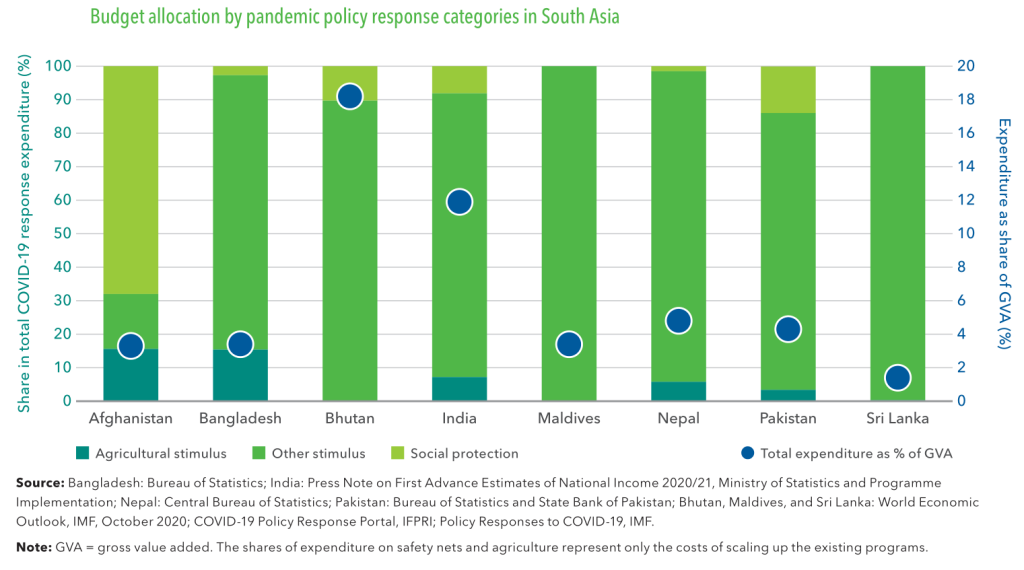
Financing Agriculture and Subsidies: The long-standing issue in Bangladesh is a lack of financing in agriculture. Bangladesh Bank has allowed banks to open bank accounts with a deposit of BDT 10 for farmers. Bangladesh Bank (BB) set a target for banks of Tk 283.91 billion (28391 crore) agriculture and rural credit disbursement target for the fiscal year 2021-22 under the Agricultural & Rural Credit Policy and Programme of the Bank. Of all south Asian nations, Bangladesh has provided the highest Agriculture subsidy during COVID. Agriculture subsidy went from around 6500 million in 2009 to around 13000 million in 2021. Fertilizer subsidy went up from 16000 crores in FY 2022-23 to 2400 crores in FY 2023-24.
Government Interventions
The agricultural sector’s contribution to the economy of Bangladesh is more than just numbers. Food security, livelihoods, export earnings, rural development, and environmental sustainability highlight its central role in driving wealth creation and overall growth in the country. The sector has been a major driver of social and political stability in Bangladesh. In recent years, the government of Bangladesh has implemented several policies and programs aimed at modernizing and diversifying the agricultural sector. These initiatives have significantly impacted the 3Ps of Agriculture: production, productivity, and profitability.
Over the past decade, Bangladesh has witnessed remarkable growth in the agricultural sector, with significant improvements in productivity, production, and rural livelihoods. The government’s commitment to agricultural development, coupled with various policy interventions and investment initiatives, has played a key role in driving this growth. Here is an overview of Bangladesh’s notable policy instruments and achievements in the agro-sector during the last decade.
The seventh five-year plan (2016-2020) allocated a significant share of its budget to agriculture, with 17% of the total budget going to the agricultural sector. The plan focused on increasing agricultural productivity, improving rural infrastructure, and promoting agricultural diversification. The plan also introduced a number of new agricultural programs, such as the ‘100 Million Tree Plantation Program‘ and the ‘National Agricultural Policy 2016‘.
NAP 2016 has been instrumental in the development of Bangladesh’s Agro dynamics. Some of the key policy points are –
- Increasing crop productivity by 5-2% per year.
- Increasing the share of processed agricultural products to 40% of total production.
- Increasing the adoption of climate-smart agriculture practices by 25%.
- Allocating at least 10% of the national budget to agriculture.
- Increase the mechanization rate in agriculture from 13% to 40% by 2021.
- The target of increasing the irrigation coverage to 50% of the cultivable land by 2021, up from around 35% at the time of policy formulation.
- Raise the public expenditure on agricultural R&D to at least 1% of agricultural GDP
The Government of Bangladesh has set a target of increasing food grain production by 50% by 2030 in the 8th Five-Year Plan (2021-2025). The plan aims to achieve this target by Increasing the area under cultivation by 10%, improving irrigation facilities by 15%, and promoting the use of high-yield varieties of seeds and fertilizers. It’s important to note that the National Agriculture Policy 2016 set these targets as part of a broader strategic framework for agricultural development in Bangladesh. These targets provided a roadmap for achieving sustainable agricultural growth, food security, and rural development in the country.
The country’s food resilience during COVID pandemic can be largely attributable to the heavy government investment to protect the farmers. Lockdowns were eased for farmers and agricultural supply chain. Later on, since the off-set of post-pandemic global crisis, the government has intervened into the market, provided production support and facilities.
- Market Intervention: In November 2022, the government announced a BDT 5 000 crore (USD 492 million) refinancing scheme for the agricultural sector, including cereals, ending on June 2024 with a maximum 18-month loan duration and a three-month grace period. The government also decided to purchase 300 000 tonnes of paddy and 500 000 tonnes of parboiled rice from the 2022/23 Aman harvest. Later in April 2023, the government further announced that it would purchase 400 000 tonnes of paddy and 1.25 million tonnes of parboiled rice from the 2023/24 Boro harvest between 7 May and 31 August 2023. Prices under the purchase drive would be set to BDT 44 per kg of parboiled rice (USD 405 per tonne) and BDT 30 per kg of paddy bought (USD 276 per tonne).
- Production Support: In December 2022, the government announced that, to assist production during the 2023/24 Boro cycle, it would destine BDT 1.7 billion (USD 15.6 million) to support 2.7 million producers across the country. Under the initiative, 1.5 million farmers would be provided with two kgs of hybrid seeds. Cultivation of high yielding varieties would also be supported through the provision of five kgs of seeds, ten kgs of di-ammonium phosphate and ten kgs of muriate of potash to producers, with additional steps taken to promote mechanization during planting and harvest. Later in February 2023, the government further announced that it would destine BDT 572.5 million (USD 5.3 million) to support 1 million smallholders cultivating Aus paddy. The funds would furnish farmers with five kgs of seeds, ten kgs of di-ammonium phosphate and ten kgs of muriate of potash.
- Import Tariff, Finance and Credit Facilities: In December 2022, the government decided to reduce import duties and charges on non-fragrant parboiled and white rice to a rate of 15.25 percent and requested the commercial banks to issue letters of credit to importers of rice and wheat at a minimum margin.
Role of Research and Development
For Bangladesh to meet its goals for nutrition and food security, agricultural R&D has been crucial. The Bangladesh government has recently made considerable R&D investments. The government provided Tk 2,100 crore in 2010 for agricultural R&D. In 2022, the government allotted Tk. 3,300 crore for R&D in agriculture, marking a 57.4% increase in the last 15 years.
There are currently seven public-funded specialized universities in Bangladesh that are dedicated to educating and preparing the next generation of farmers. These agricultural universities play a significant role in providing higher education, research, and training in various fields of agriculture, veterinary sciences, and related disciplines. Graduates of these institutions are already showing their skills in Technology driven efficient and smart Farming. On top of that, Agro-research institutions of GOB notably the Bangladesh Agricultural Research Institute (BARI), Bangladesh Rice Research Institute (BRRI), Bangladesh Jute Research Institute (BJRI), Bangladesh Sugar Crop Research Institute (BSRI), Bangladesh Livestock Research Institute (BLRI) have been working on high yield, genetically modified crops, improved technologies and practices, and by providing extension services to farmers.
Initiatives For Agricultural Resilience
- National budget: The agricultural industry has recently received major funding from the government. For instance, the government has committed Tk. 35,374 crore to the agricultural sector in the 2022–23 budget, an increase of 4.97% over the prior year. A total of 205 rebates will be provided for the use of electricity for irrigation pumps. 70% cost in haor and coastal areas and 50% in other areas will be covered as development aid. Several activities will be supported by this funding, including crop diversification, irrigation and water management, agricultural research and extension, and private sector investment.
- Agro subsidies: The government provides several subsidies to farmers, including subsidies on fertilizers, pesticides, and irrigation equipment. These subsidies help to reduce the cost of production for farmers and make it more affordable for them to grow crops. In the proposed budget for fiscal year 2023-24, the government will be providing Tk. 24,000 crore as fertilizer subsidy, up from Tk. 16,000 crore in from the previous year. Subsidy on food will be increased by Tk.800 crore to 6,766 crore. Proposals have been made to waive the advance tax on the import of rice transplanters, dryers, potato planters, and prayer machines.
- Cash assistance: Farmers that are impacted by tragedies or natural disasters can potentially receive financial aid from the government. The expense of food, seeds, and other agricultural inputs is somewhat offset by this support. On the aftermath of Covid 19, Farmers received cash aid from the government totaling Tk. 2,000 crore (US$22 million) in 2021.
- Incentive program: Incentives for farmers have also been introduced by the government through the “Farmers’ Income Enhancement Program” and the “Providing Agricultural Land to the Landless Farmers” program, among others. In order to help farmers raise their output and revenue, these initiatives offer them financial support, education, and other resources.
Sustainable and Resilient Agriculture: A Case of Value-Added Partnership
Bangladesh has emerged as a role model in sustainable and resilient agriculture, showcasing a value-added partnership model that can serve as an inspiration for the world. The country has made significant progress in addressing the challenges of climate change, limited resources, and growing food demand through innovative strategies and collaborative efforts. Here is a brief overview of Bangladesh’s achievements and the key development projects that make it a model for sustainable and resilient agriculture:
- Agricultural Value Chain Development Project (AVCDP): Funded under the Feed the Future initiative, this project strengthened 10 agricultural value chains through a rangeof tools, platforms, and agreements to implement large-scale, systemic interventions from 2013-2019 through a market system approach to agricultural value chains in Bangladesh’s Southern Delta, home to 30 million people where poverty and under-nutrition are acute and persistent, agricultural productivity is low, and farmers are not typically linked to markets. The project helped facilitate $19.4 million in new private sector investment and ultimately benefitted 307,419 rural households. The project helped to forge partnership with 42 private sector companies and cooperatives to ensure sustainable supply of inputs and transfer of appropriate technologies which created 111,662 jobs, reached 305,408 farmers with new technologies and management practices that increased crop yields by 131 percent. It also established the cut flower sector as a formalized industry in Bangladesh, growing the market from $67 million in 2013 to $150 million in 2018. The project introduced high-yielding and disease-resistant variety of mung bean, which led to a 4 percent yield increase per hectare, and increase in average net income of farmers by $64, or 78 percent per hectare. Environmental factors include reduction of chemical and fertilizer spray by 70 to 75 percent, and reduction of smallholder seasonal input costs by as much as $750 per hectare.
- Integrated Agricultural Productivity Project (IAPP): The IAPP is a $50 million project that was launched in 2017 and ended in 2022. The project was funded by the International Fund for Agricultural Development (IFAD) and implemented by the Ministry of Agriculture. The project introduced climate smart agricultural technologies, agronomic practices, crop varieties, and production technology packages in target areas. More than 250,000 crop, fish, and livestock farmers benefitted from this project, of whom about a third were women. Further, IAPP contributed to an increase in income levels by 15 percent for crop farmers and 37 percent for fisher folk between 2014-2016. Close to 85 percent of crop farmers and 98 percent of fish farmers reported a better food consumption for their family.
- Agriculture, Nutrition, and Gender Linkages (ANGeL) Project: The $30 million ANGeL Project began in 2018 and is expected to be completed in 2023. The Ministry of Agriculture is carrying out the initiative, which is supported by the United States Agency for International Development (USAID). The initiative promotes sustainable farming methods, agriculture that considers nutrition, and interventions that are gender-responsive in order to increase agricultural productivity, nutrition, and women’s empowerment. More than 2 million individuals, including 1 million women, are anticipated to gain from the programme.
- Sustainable Coastal and Marine Fisheries Project: A $20 million project with a 2024 completion date, the Sustainable Coastal and Marine Fisheries Project began in 2019. The Ministry of Fisheries and Livestock is in charge of carrying out the initiative, which is sponsored by the Food and Agriculture Organization (FAO). The initiative aims to improve the livelihoods of fishing communities, increase the sustainability of coastal and marine fisheries, and promote ethical fishing methods. Over 100,000 fishing households are estimated to benefit from the project.
- Comprehensive Disaster Management Programme (CDMP): The $15 million CDMP project began in 2020 and is expected to be completed in 2025. The Ministry of Disaster Management and Relief is carrying out the initiative, which is supported by the European Union. To lessen the effects of natural catastrophes on agriculture and rural life, the initiative intends to improve agricultural sector disaster risk management capabilities. More than 5 million people are estimated to gain from the project.
Private Sector Initiatives
Private sector has also been able to contribute to the development of Bangladesh’s agriculture through various initiatives like I-farmer, WeGro, Freshie farm, Fashol etc. In terms of agri-tech there are many private initiatives at present. KhaasFood, Permeeda, FishBangla, Gormet Bazar, Bengal Meat, Chaldal etc. are market-linkage agri-tech companies that are currently operating in Bangladesh.
Future Challenges
While Bangladesh’s agricultural industry has made considerable strides and progress recently, there are still a number of obstacles to overcome before it can continue to grow and become more sustainable. Climate change is one of the main issues since it threatens agricultural productivity and food security because it causes rising temperatures, unpredictable rainfall patterns, and extreme weather events. The agro industry may invest in climate-resilient crops and practices, support water-efficient irrigation systems, and use sustainable land management methods to meet this problem.
Given Bangladesh’s high population density, a lack of arable land presents another difficulty. The agro industry may combat this by pushing hydroponics, vertical farming, and other cutting-edge agricultural techniques that enhance land use effectiveness. Additionally, funding for agricultural research and development can contribute to the creation of crop types that are more resource- and land-efficient while yet producing high yields.
Another significant difficulty is ensuring smallholder farmers have access to financing and agricultural loans. The agro industry can work with financial organizations to create specialized financial services and products for farmers, such as microfinance and insurance programs. This would make it possible for farmers to spend money on cutting-edge agricultural equipment, inputs, and technology, boosting output and profitability.
It is also crucial to upgrade the value chain infrastructure and post-harvest management. To decrease post-harvest losses and increase the value addition of agricultural products, the agro industry can invest in cold storage facilities, transportation systems, and processing facilities. It is possible to further improve farmers’ knowledge and abilities in effective productivity, pest management, and sustainable farming methods through strengthening agricultural extension services and farmer training programs.
Lastly, farmers’ financial security depends on ensuring that they have access to markets and receive fair prices. To link farmers directly with consumers and lessen reliance on middlemen, the agro sector can create market links, encourage farmer cooperatives, and assist the growth of agribusinesses. In addition to helping the agricultural sector grow and sustain itself, this would allow farmers to get fair rates for their goods.
By addressing these challenges and implementing appropriate strategies, the agro sector of Bangladesh can maintain its growth momentum, enhance productivity, ensure food security, and contribute to sustainable development in the country.
References
Faostat. Available at: https://www.fao.org/faostat/en/#data.
Agricultural land (sq. km) – bangladesh World Bank Open Data. Available at: https://data.worldbank.org/indicator/AG.LND.AGRI.K2?locations=bd.
Bangladesh Open Data: Data For All Bangladesh Open Data | Data For All. Available at: http://data.gov.bd/.
Bangladesh Statistics 2020 – bbs.portal.gov.bd. Available at: https://bbs.portal.gov.bd/sites/default/files/files/bbs.portal.gov.bd/page/a1d32f13_8553_44f1_92e6_8ff80a4ff82e/2021-05-14-06-22-47723b0e1476ed905d1c121f8f07d935.pdf.
Bangladesh USDA Foreign Agricultural Service. Available at: https://www.fas.usda.gov/regions/bangladesh.
Sarwar (2023) National Budget 2022-23 summary: Agriculture: CPD, Centre for Policy Dialogue (CPD). Available at: https://cpd.org.bd/publication/national-budget-2022-23-summary-agriculture/.
About the Authors

Tanmoy Dhar is an Economics graduate from the University of Dhaka. He has served an associate at CounterFoto- A Center for Visual Arts.
Najib Hayder is the Blog Manager at The Confluence. Formerly he has served as the Head of Policy Dialogue at Youth Policy Forum. A former debater, business graduate by chance and policy-enthusiast by choice.