After developing Bangladesh’s ready-made garments (RMG) industry and other light industries, it’s about time Bangladesh ventures into heavy industries with higher return. Every developing country at some point needs heavy industries to develop in order to excel the economy. It’s time to venture deep into the global value chain. Can our automotive industry be a beacon of hope?
The Automobile Industry Development Policy, 2021 has been adopted with a view to increasing local value addition to the production of automobiles in Bangladesh. A significant number of automotive factories and companies have long been operating in the country and have been quite successful in a lot of instances which need further propulsion at this point.
Existing Automobile Market - Ever Expanding
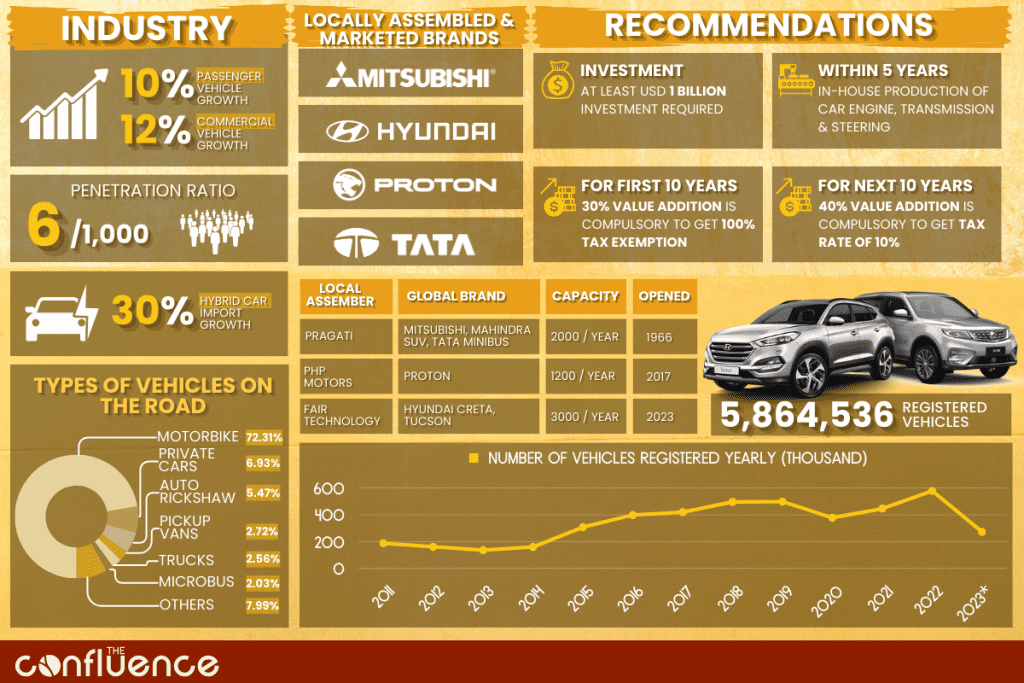
The automobile market of Bangladesh is growing and it is growing rapidly. According to data provided by Bangladesh Road Transport Authority (BRTA), registration of new vehicles in Bangladesh has constantly been above 400,000 every year. In the last decade, until the outbreak of COVID-19, the number of new vehicles registered by BRTA reached around 500,000 in 2018 and 2019. After the pandemic, the number of newly registered vehicles is reaching around 600,000 according to 2022 data.
But this growth is not uniform across all segments of motor vehicles. Sales of motorcycles have increased rapidly compared to the other segments. The total number of registered motorcycles have increased from 0.67 million in 2010 to 4.2 million in 2023, which is more than 5 times in just 13 years.
The number of other vehicles such as cars, three-wheelers, buses and trucks have also increased. Goods carriage vehicles such as trucks, covered vans, pickups etc. has increased from 0.12 million in 2010 to 0.41 million in 2023. It is a noticeable more than 3 times increase in 13 years.
The number of cars have doubled from 0.34 million in 2010 to 0.68 million in 2023. Even though the number of cars have increased, but not as fast as motorcycles, trucks and three-wheelers.
Current Industrial Production
According to data provided by BRTA, Bangladesh is registering a growth of 500,000 vehicles every year. But what is important to note here is that, motor vehicles can be imported in two ways – Completely Built Units (CBU) and Completely Knocked Down (CKD). CBUs are completely built cars, where CKDs are imported as parts of cars. According to the Automobile Industry Development Policy, 2021, CKD imports have separate engines, gear boxes, shafts and other body parts, which are further assembled in Bangladesh. Currently, the automobile industry of Bangladesh focuses on assembling vehicles after importing CKD units. The industry has so far been producing three wheelers and assembling trucks, motorcycles and cars.
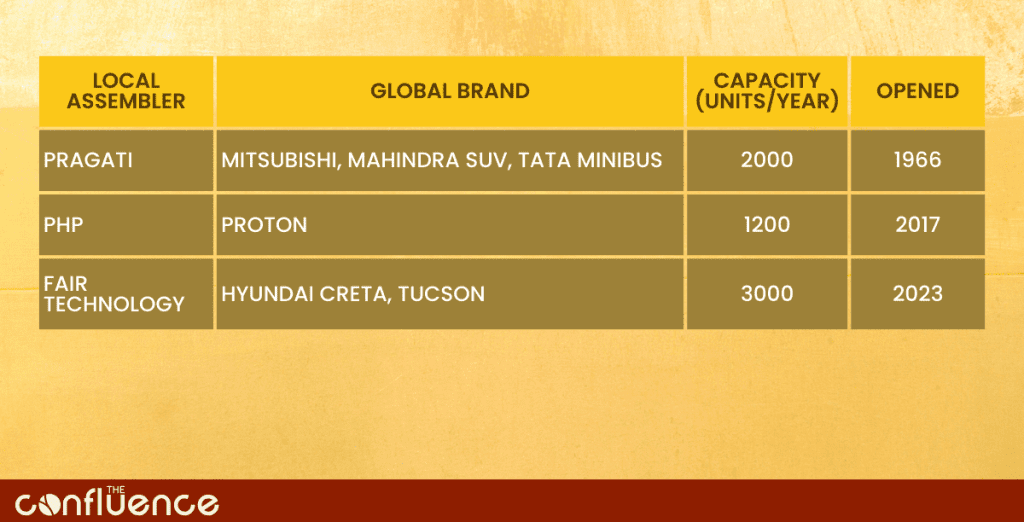
Assembling cars in Bangladesh began as a government initiative, under the state-owned Pragati Industries Ltd. has assembled over 50,000 vehicles since its inception in 1966 (Bangladesh Steel and Engineering Corporation, 2013). Pragati’s assembling facilities can assemble 2000 vehicles every year.
PHP Automobiles has launched the Bangladeshi assembled Proton Preve in partnership with Proton in March 2017, which currently assembles Proton Preve, Proton Saga, Proton X70, Proton Persona and 8-seater microbus PHP Shineray X30. PHP Automobiles has the capacity to assemble 1200 cars every year.

Earlier this year, Hyundai started assembling cars such as Hyundai Creta and Tucson in collaboration with Fair Technology at the Bangabandhu Hi-Tech Park, with the highest assembly capacity so far, of 3000 vehicles every year, with a plan to gradually increase the number to 10,000 units annually.
Assembling Motorbikes
Foreign Brands
Foreing global brands such as Yamaha, Honda and some Indian brands such as Hero, Bajaj, TVS etc. assembles their motorcycles in Bangladesh, usually in joint ventures with Bangladeshi distributors. They import parts, i.e. completely knocked down (CKD) units that are assembled within the country.
In 2019, ACI Motors established Yamaha Motorcycle Assembly Factory in Gazipur with an annual assembling capacity of 60000 units.
Honda began manufacturing bikes in the Abdul Monem Economic Zone, Munshiganj in 2018, in collaboration with Bangladesh Steel Engineering Corporation (state-owned) with a capacity of assembling 100,000 units annually. Later in 2021, they expanded their operations in engine assembly.

Rancon started assembling Suzuki motorcycles in Bangladesh in 2014. Currently they hold a significant presence in the market.
Uttara motors started assembling Bajaj bikes in Bangladesh in 2014 in their Zirani Bazar plant in Gazipur, with an annual capacity of 150,000 units. Bajaj has also agreed to manufacture parts of motorbikes in Bangladesh.
Atlas Bangladesh, a state-owned company under Bangladesh Steel and Engineering Corporation has started manufacturing TVS bikes in Gazipur, with a capacity of assembling 200 TVS motorcycles daily.
Nitol-Niloy Group assembles Hero motorcycles in Bangladesh from 2014 in collaboration with Hero MotoCorp with an annual capacity of 150,000 bikes.
Karnaphuli started assembling Chinese Haojue bikes in Tongi from 2014. The plant has a capacity of assembling 1500 bikes per month, totaling 18000 a year.
Domestic Brands
Domestic brands such as Walton, Runner and H Power usually import parts from other countries that they assemble within the country. Their difference with foreign brands that assemble within Bangladesh is that the motorbikes sold by domestic brands are designed by the Bangladeshi companies.
Walton has produced motorcycles in the country for the first time. Walton Hi-Tech industries have an annual capacity of 300,000 motorcycles, set up in 2006.
Then came Runner Automobiles, which imported Dayang bikes since 2000, but started assembling in 2009 and later opened a manufacturing plant in 2012. They have an annual capacity of 100,000 motorbikes with an intention to expand in future. Around 40-50% of the value of a Runner motorbike is added in their manufacturing plant in Bangladesh.
New Grameen motors started as distributors of Chinese manufacturers in Bangladesh. But currently they have established their own brand, H Power with a capacity of producing 50,000 motorcycles per year.
Halted Operations
Aftab Automobiles started assembling Mahindra bikes in 2013 with its factory in Chattogram that had an annual capacity of 10,000 units, which later shut down due to Mahindra’s bikes failing in competition with other manufacturers..
A few other Chinese motorcycle assemblers and distributors operating in Bangladesh include Rasel Industries Ltd. (Lifan), Speedoz Ltd, Roadmaster Motors Ltd. (Dayun) etc.
Assembling Trucks

In 2017, Ifad Autos Limited, in collaboration with Ashok Leyland established a manufacturing facility located at Dhamrai with an installed production capacity of 600-800 vehicles per month and they aim to cover 90% sales to be manufactured from this plant.

Nitol-Niloy group has started assembling Tata pickups in their Jashore plant, with a capacity of 800 pickup trucks per month from 2020. Tata plans to set up a passenger vehicle manufacturing plant in Bangladesh for domestic customers as well as markets in northeast India.
Lorem ipsum dolor sit amet, consectetur adipiscing elit. Ut elit tellus, luctus nec ullamcorper mattis, pulvinar dapibus leo.
When will we stop importing reconditioned cars?
Bangladeshi people can buy brand new motorbikes. Thanks to the assembling facilities that enable companies to import CKD units and assemble within the country to pay lower taxes. One of the reasons why companies prefer assembling bikes in Bangladesh is that we buy a lot of bikes every year. Companies can attain the economy of scale by assembling in Bangladesh and availing tax cuts. But what about cars?
Bangladesh has 12 million people who are considered middle-income and it is increasing. Meanwhile importing cars require import duties ranging from 130 percent to 850 percent, depending on the Engine CC. In that case, importing brand new cars becomes very expensive. Therefore, it is cheaper to import used and reconditioned cars and resell in Bangladesh. Bangladesh Reconditioned Vehicles Importers and Dealers Association (BARVIDA) has 900 enterprises who import reconditioned vehicles.
However, to inspire car assembly in Bangladesh, the government has imposed an 89% tariff on partially assembled vehicles regardless of their engine CC, which is much lower than the tariff on imported cars. This policy ensures that in order for companies to sell brand new cars in Bangladesh, they have to import semi-knocked down or completely knocked down units and assemble within Bangladesh.
Companies like Hyundai and Proton are trying to rip the benefits of it. Hyundai began with assembling Creta in Bangladesh and later, started assembling their flagship Tucson as well. Bangladeshi assembled Tucson cars cost 10.5 lac less than what importing CBU would cost. Considering the huge tax cut, it still is much higher and the company can make considerably higher profits. As long as imported reconditioned cars are allowed, due to higher taxes, the market price of cars will always be higher and even locally assembled cars will be sellable in a higher price and profit markup, making cars costlier. Hence, the people of Bangladesh willing to buy cars will not be able to afford one even if cars are assembled locally.
Looking at India’s example, their economy is more stable in times of global financial crisis and post-COVID shocks compared to Bangladesh. Most of the vehicles on the roads of India are manufactured in India. Hindustan motors started assembling cars in 1948 and later they started producing their flagship Ambassador classic cars in 1956 which were designed by Morris. The iconic Yellow Taxicabs of Kolkata are mostly Ambassador cars. Later, Hindustan Motors were followed by companies such as Tata, Maruti, Mahindra etc. Now they have SUVs such as Mahindra Thar, their own production. It might have taken a few decades, but finally they are manufacturing cars. At one point Bangladesh should become self-reliant for its vehicle production. And it begins with assembly plants. Later on, we can hope to expand and venture into production of parts and eventually manufacturing engines. But it cannot start if we encourage importing reconditioned cars and
About the Author
Najib Hayder is the Blog Manager at The Confluence. Formerly he has served as the Head of Policy Debate at Youth Policy Forum. A former debater, business graduate by chance and policy-enthusiast by choice, currently pursuing Masters in Development Studies at the University of Dhaka.